Thursday, January 28, 2016

Happy first anniversary, Istanbul!

One year ago, I got on an unmarked Egypt Air plane for my one-way ticket bringing me (back) to Istanbul. Leaving Cairo was a difficult decision--I was leaving my friends, leaving the place that had been home for years. Unlike when I left the year before, this time I knew it would be very unlikely I would return as a resident.

Me and little baby Ziza monster, Istanbul bound!
What changed in that year? While I love Egypt, the move was a long time coming. The rise of Sisi brought a crackdown on dissent and a feeling of morose among those who considered themselves revolutionaries. My friends, both Egyptian and foreign, began to leave. The difficulties of every day life, namely the harassment, were no longer manageable. Or perhaps before I was better able to deal with it because there was hope, the promise that things would get better, a feeling that I was in a place moving forward. But Egypt stopped moving forward. Instead, it went backward. The crackdown on dissent, the disappearances, the extrajudicial killings. It's all worse than under Mubarak.

A few days before I left, leading up to the fourth anniversary of the January 25 revolution, activist Shaimaa Al-Sabbagh was killed while trying to lay a flower down, peaceful protest. Police shot her at close range with bird shot. Seeing her image, the sadness in her friend's eyes... I went home and drank a bottle of smuggled wine because I just could not deal with it anymore. I internalized Egypt's politics too much. I asked some of my formerly active friends how they dealt with it--they said they stopped caring. But I kept on getting angry. I kept on getting sad. I began to think only distance would make this feeling go away.

Egypt's infamous sexual harassment also took its toll. I could no longer walk past a male on the street without tensing up, getting quiet being scared, without bracing for physical contact. When I moved to Egypt, I wasn't a violent person. After a year, I started to want to hit the guys on the street. Then I wanted to shoot them. At the end, I didn't want to shoot them. I wanted to make them suffer, to really feel the pain and fear they inflict on women every day. I wanted to kill them slowly and painfully. Not normal.

It got to the point I didn't like any kind of physical contact, any kind of compliments after being sexually degraded on the streets for so long. At the end of my stay in Egypt, I stopped going out completely. Fuck it--not going out to be sexually harassed. I'll just sit at my apartment with my fur ball.

I was once in Vienna, Austria, and a group of Austrian teenage boys were walking behind me. I got so angry--why were they there? What were they saying? My heart was racing. Borderline PTSD.

Now, one year later, I can walk past groups of men--old men, young men, middle aged men--and not think twice. For the most part, people don't even look at me. Sometimes I meet eyes with a male stranger--and nothing. He doesn't take it as a come on. We just look away. Sometimes I notice that I'm passing by a group of shabaab-looking kids--and they don't even look at me. They just continue doing what they're doing.

I love the fact I can walk in the streets here, ride the metro, and be anonymous. I'm just another person, just like everyone else. In Egypt I felt like a peacock.

I no longer get scared. That is probably the most important change, and something I would never give up again.

Thursday, October 8, 2015

“Please don’t step on the bones”

Between 1975 and 1979, over a span of fewer than four years, 3 million out of a population of 7 million were killed by the Khmer Rouge. An astounding number—nearly half the population. But this number discounts those killed from overwork, from starvation, from disease, from long marches. The true number of those lost is much higher.

I knew the basics about the Khmer Rouge—communist authoritarian regime that killed a lot of people. But until I came to Cambodia, I admit I didn’t know much.

Bones collected on the side of the path.
Clothing of the victims emerging from the ground.
Over half the population was wiped out. Today, Cambodia is a very young population—very few people over 40. They lost an entire generation. I’ve seen a lot of people with missing limbs, likely taken off from landmines. After the fall of the Khmer Rouge, one of the biggest killers of Cambodians was landmines.

I’ve been to concentration camps in Germany, to Schindler’s factory in Poland, but neither of those trips left the same impression on me as the killing fields in Cambodia. The country is littered with mass graves, some yet to be discovered. Outside Phnom Penh is Choeung Ek killing field where mass graves containing the remains of  8,895 people were found—some headless. One mass grave full of babies. One of women and children. There's a tree there against which they swung babies to kill them.

The impact isn’t from the sheer number of bodies found. It isn’t from the monument that acts as a resting place for the exhumed bodies—skulls, bones, on display.  The impact comes from the fact that the field continues to be littered with bones, with bits of cloth, that the rains and erosion have pushed up. As you walk, you have to look down to make sure you’re not stepping on bones. Brightly colored clothing is partially visible. I was literally dodging the dead. There were even bones lodged in tree roots.

Political prisoners were sent from a prison in downtown Phnom Penh, a complex that was once used as an elementary school. Today, you can visit the elementary school and see the mugshots of the prisoners.

Mugshots found in S-21, the elementary school turned prison complex.
After weeks of torture, victims were sent to the killing fields for immediate death. They were not shot—they were not worth the bullets. Instead, their heads were bashed in, their necks broken, their necks slit with palm leaves. They were made to dig their own graves. Those who survived the beating either suffocated to death in the pit or died when the Rouge poured chemicals on the bodies—to get rid of the stench and to kill off anyone who may have survived. They left no survivors.

Despite all of this, despite the fact Cambodia remains a poor country, Cambodians are happy, smiling, welcoming. I don’t feel hostility as a tourist, as an American (the US supported the KR, a Chinese-supported commie party, as a counterbalance to the Soviet-supported Vietnamese commies. If you play the communists against themselves, the ideology will not spread). People come to talk to you. They offer you their wares at the tourist shops, at the stalls, but if you say no thank you they drop it. No hassling, not pushy.

Today, the prime minister is a former KR official. The Cambodians have sought the path of reconciliation—if you killed my father, what will killing your father do? Will it bring peace? Or eternal war? As would be expected, hard feelings remain. Our tour guide who took us through the complexes told us how the regime killed his father, tore apart his family. After Pol Pot, the leader of the KR regime, died, our guide went to the site where his body was cremated. He said he wanted to piss--he said it with anger, with pain, with sadness, with resignation. Coming from a religious man, I could feel this meant a lot. Yet he could not, because the site was littered with offerings--a sign that to this day, there are those in the country who still support the Khmer Rouge.


Monday, June 15, 2015

My finest moment

I'm on a lovely holiday in Portugal. Over the last three days, just about everything has been great--the weather, the food, the wine.

I noticed a lot of harassment. The old men would come up to me. The young would say something under their breath as I walked by. I laughed it off initally--oh, nothing can be as bad as Egypt. Child's play.

Tonight, my last night in Porto. I went out to a great restaurant on the Douro River. Got a delicious octopus dish. Great scenery. The sun was setting. I finished my dinner and headed out.

As I walked out of the restaurant, three older men were sitting out and made a hissing noise as I walked by. Conditioned to this, I kept on walking. Halfway through the next restaurant, I stopped. Why am I putting up with this shit? I went back and thoroughly bitched them out. They said they were just trying to tell me that my eyes were beautiful. Blah blah blah. I can call the cops if I want.

I don't give a shit. I stood my ground.

Every woman who saw gave me the thumbs up. They can go fuck themselves. At the time I felt satisfied, vindicated.

After years and years of this shit, I finally said something. Even more, all these women were on my side.

About two minutes later, I stopped. I called my mother. Why is it that this is the norm everywhere I go? Why can't I go to the grocery store, or to a restaurant, or to the corner kiosk without getting hit on? Why is it that no matter where I go-- Egypt, Turkey, Portugal/Europe, Dc/USA, I'm never a person, but a woman? And even more so, why is it that every woman who saw this felt the same--yet none of the men did?

Years and years in Egypt, I would be harassed, followed, groped. You don't say anything--when you do, it escalates. It becomes physical. It's better to be quiet. When I resisted, I got dragged from a moving vehicle. But there's worse.

There was a girl who caught the headlines in Turkey. She was murdered for resisting rape.

I told my mom that I wish the men who acted this way would die. I wish they would experience a slow painful death. I wish that they could feel the fear, the pain of all the women gang raped. Murdered. I want them to feel the terror those girls felt. And seeing that written out is scary--the girl who never believed in corporal punishment.

The feeling of being a second-class citizen is overwhelming. My entire purpose of being is to please others. My eyes are beautiful, my ass is beautiful, and that makes me not even worthy. But, I'm there.

Is this normal? I don't even know anymore. All I know is I spent the last day in Porto on the phone with my mom. Never saw the sun setting on the Duoro. 

Wednesday, June 3, 2015

A tale of golden toilets

Turkey's parliamentary elections are around the corner, elections that could be considered the most important in history. Not only is the parliament in the balance, but the parliamentary system is as well. Ex-prime minister and current president Erdogan announced plans to turn Turkey into a presidential system (what a coincidence! Now that he's president, he wants to put all the power in that office).

An upstart political party called the HDP that was once considered aligned with Kurds and therefore terrorists/separatists but now gaining popularity across the board is in a position to potentially block this--if they reach the 10 percent threshold, Erdogan and his followers won't have enough support for the presidential shift. The HDP is going for inclusivity, fielding a roster of not only Kurdish activists, but socialists, religious Muslims, minority candidates including Roma and Armenians, and a transgender candidate. If they lose, however, the seats they gained will be divided between the winning parties, making the AKP even stronger.

Erdogan surrounded by his Ottoman-style guards


I am not convinced Erdogan will lose this election, even if he loses the vote. Funny business tends to happen during Turkish elections (like a stray cat who got into a transformer and cut the electricity right as vote-counting began in an anti-Erodgan area). He's made it clear he is in charge of Turkey and that he has no intention of compromise, let alone ever leaving. 

A man who was once considered a modernizer now surrounds himself with Ottoman-styled guards in a bizarre and controversial $615 million palace he built on what was meant to be conserved land. His rants about golden toilets are grabbing headlines here, rants that followed him daring those who opposed the construction of his palace to come down and take it from him. He has engaged in verbal warfare with both foreign and local journalists. He singled out the NYT for its coverage, calling it and its former Turkey head and "enemy" of himself and the state. He has sued a local journalist for coverage on shipments of arms from the Turkish equivalent of the CIA to Syrian fighters. That journalist has been threatened by the prosecutor general with a life sentence due to his "espionage." In rhetoric that echos Egypt, he accuses the NYT, CNN, and the BBC of trying to weaken and divide Turkey. While these accusations and actions border on farcical, the stifling effect can be felt. Whenever he speaks, the stock market crashes. 

Erdogan is everywhere despite the fact he's not actually running for office. His face, never a smile, looks down on us in the metro, on buildings, in tea shops. Election propaganda is technically banned from public transport, yet Erdogan's face beams down from buses and inside the metro. Erdogan, as president, technically is nonpartisan, although he admits to having the AKP in his heart. 

Some may pass this off as election season blovating, but I think he actually believes the stuff coming out of his mouth. He sees an enemy around every corner. He believes the opposition parties are conspiring against him (which, to be fair, is true as that is the entire point of being in the opposition). This is an election about him, not about Turkey, not about the Parliament. That his words aren't just rhetoric is what makes the situation so difficult. 

Monday, April 6, 2015

Fear

After a long hiatus, I'm back at the blog.

Last June, I returned to Egypt from Turkey. I was burned out from my job in Istanbul. I had no time to make friends or enjoy the city that people told me was awesome. I was generally unhappy. I missed my crew in Cairo, missed the sense of community and the way of life. Things are more difficult there, but at the same time more real.

After six months in Sisi's Egypt, I left and returned to Istanbul. I had been there for his takeover, but this time it was stifling. The cult of personality, the hostility toward those who did not accept the official narrative without question, became too much. People began to joke about being disappeared, informed upon, detained--jokes that are only actually funny when there's a chance it may happen. One day, traffic was stopped for a VIP on a major street in the middle of rush hour. The driver I was with started irately honking--the cabbie next to us half-jokingly told us to stop or we would all be detained. Friends would post things on facebook with the disclaimer "Don't inform on me" (haha).

One night I was out to dinner with friends and we started talking about politics. I told them to hush, to speak quietly. They thought I was being paranoid. We went home and read about how that day, journalists were arrested in a cafe downtown for the same crime. And don't even get me started about journalists. Journalists who do not have international attention--Al Jazeera guys--are left in prisons, forgotten, held indefinitely without charges and without any venue to justice. By virtue of being "only" Egyptian, of having the wrong passport. Of working in their own country.

I wasn't the only one who left. My Egyptian friends began to leave in droves--for masters, for jobs, for anything. Those who stayed largely disengaged from politics. It's the only way to stay sane, one former activist told me.

On the fourth anniversary of January 25, I came home from dinner with my friends, opened Facebook and Twitter, read about a peaceful protester getting killed by bird shot. Social media circulated a photo of her, blood coming out her back and mouth, a shocked expression, with a friend frantically grasping her waist. Later, we learn the police attempted to accuse one of her party members with her murder. Then the Muslim Brotherhood. Police refused to call for help for the shot woman, and also arrested those who tried to help her. They dragged the men away, left her dying, slumped on a plastic chair in the middle of downtown Cairo.

Now, her party members have been slammed with charges of participating in an unregistered protest, with up to six years in jail. This, as the likes of the Mubaraks and Habib al-Adly walk free.

I finished a bottle of wine by myself that night. Her death was the nail in the revolution's coffin.

It of course didn't end with me leaving. Ahmed Samih, the director of the Andalus Institute for Tolerance and Anti-Violence Studies, a leading human rights activist, was detained following a raid on his office. He is also the head of Radio Horytna and, incidentally, my first employer in Cairo. His case is just one of many in an attempt to stifle civil society. Radio Horytna is a nonpartisan, unaffiliated online news portal. Because Egyptian news is controlled by the government and total shit.

Egypt had become like that--an endless cycle of lost hope, repression, jumpiness. I would open the news and get angry every day. I would drive to my house from the gym--maybe 15 minutes--and get stuck in multiple checkpoints. When I was with Egyptian males, they would get pulled over and harassed by the police. The police were making the point--we are back, and we are back with a vengeance. Their presence was ostensibly about protecting the people, but in reality their presence is keeping the people down. I see that here in Istanbul too-tens of heavily armed police standing in the middle of Istiklal, a pedestrian shopping street, with their hands on their automatic weapons, riot gear in hand. Who are you protecting? Who are you serving? The people you are only too antsy to shoot?

Turkey recently passed a law allowing security forces to use live fire against protesters with firecrackers or anything like that. In the middle of the afternoon on Istiklal, surrounded by shoppers, tourists, and random passers by, I've been in the vicinity of a protest that erupted and firecrackers start going off. What is to happen then? Judging by the police's use of tear gas and water cannons (indiscriminate), I--and many others--are less than comfortable.

There are also reports Turkey just banned Facebook, Twitter, and YouTube. It's a losing battle, my friend. The information is out and people will always find a way to access it. You will just be chasing your own tail.

But when it comes down to it, who are these governments afraid of? What do they fear? Is it the very people they serve?

NOTE: I write this with recognition of the limitations and acts of violence of the police in my own country. I am writing about MY experience. I don't live in the US so don't accuse me of ignoring brutality elsewhere. 

Friday, November 7, 2014

A cop on every corner

The morning after the removal of Morsi from power, I was astounded to walk down from my flat and see a white-uniformed police officer. After about a year and a half in Egypt, I could not recall seeing one before. As I walked to the gym, I was taken aback by how many there were now—not just one but a handful. Also some APCs, but that was a different issue. Citizens were going up to the officers, shaking their hands, thanking them for their service, and celebrating the ousting of the erstwhile president.

Today, over a year later, the police are still on the street. In recent months, there has been an uptick in checkpoints in and around Cairo. From my house to a location about twenty minutes away, I was stopped at two checkpoints. These checkpoints are often in the middle of busy streets, in the middle of rush hour. Traffic, already jammed, stops. What are they checking for? Ostensibly, terrorists. Since Morsi was removed from office, Egypt has experienced a wave of bombings and armed attacks, mostly aimed against members of the uniformed services. But there’s a sense of unease whenever I have approached a checkpoint, whether I am with a foreigner or an Egyptian.

On the ground, it feels like these checkpoints are aimed at you. You drive up and you get scared. What do I have on my phone? What do I have in my purse? It’s a similar feeling whenever I go through any kind of airport security here. One guy a few months ago was arrested for possessing a drone—a motorized helicopter toy for his kid. There are many stories like this, and after hearing them over and over, you realize it only takes one guy who decides your two laptops mean you’re a spy and ma’salama, hope you enjoy Egyptian prison.

When I first arrived in the early summer of 2011, I was at a grocery store and a policeman tried to cut in line. All the people behind him said absolutely not, you go back in line. He did. Hard to think that would happen now. Because the checkpoints are a show of force, a sign that we’re back to business as usual.

A few months ago, there was a break in in one of the apartments in my building. The victim of the theft, a diplomat at the Russian Embassy, hired plainclothes police to find out what happened (because, of course, regular police can’t do it). For days, random men sat in the lobby. One day, some random guy came up to me and asked who I was, what I was doing here, am I registered to be here, and wanted to see my passport. Random Egyptian man with no uniform—absolutely not. I asked to see his badge, which he did not show to me. He told me he was police only. He followed me into the elevator and rode with me to my apartment. He kept on asking these questions—and only of me, not of my fellow elevator passenger, an Egyptian. Not wanting to get my roommates involved, I gave him a photocopy of the passport when we got to my door, hoping that would be enough. Twenty minutes later, he and four other large, plainclothes men came to my apartment and rang the doorbell. Absolutely did not answer it—never would I answer the door with five strange men standing outside. But they stayed for a long time, kept on knocking on the door. It was threatening, and in no way would it ever be acceptable for five strange Egyptian men to go into a girl’s apartment. My roommate said they were just doing it to scare me—and it damned well did. I messaged my journalist friend who I was supposed to meet for dinner that if I don’t show up, he should write a story about how these guys were sitting outside my apartment. Only half-joking.

During the Mubarak days, these checkpoints were rampant throughout Cairo. Police would detain random people, torture them, and get them to admit to unsolved crimes. Or just detain them, disappear them for no reason whatsoever. And slowly, that feeling of invincibility of the uniformed services is coming back.

All of this is taking place during a time where press freedom is nonexistent. Local newspaper editors agreed a few days ago to not publish anything critical of the government—we are in a war against terror, after all. All NGOs will have to register with the government under a new law that critics say will infringe on the organizations’ independence, give the government undue sway over what they do. To be honest, democracy and human rights NGOs will be nonexistent or token in Egypt in about a week. Bassem Youssef and other lesser-know open-minded media folks, such as Yousry Fouda, have resigned, silenced by pressure from the government. Egypt’s human rights practices are under fire in the UN, and local human rights NGOs refuse to cooperate with the international organization, saying the pressure and threats they have received from the government is too great. Because what is a better way to convince the world “Egypt is open for business,” Egypt is “moving forward,” Egypt respects human rights than to threaten human rights activists. They talk about—and most likely do—monitor social media, the Internet. To actually see these changes taking place, to feel the fist of the state clamp down on the press, on activists, on any form of dissent or even opinions, is suffocating. 


The government announced plans to create civilian, neighborhood watch-type organizations with the power to detain. They ask people to inform. My friend today posted a story mildly critical of the government, and I commented, “You only say that because you hate Egypt.” He responded, “Don’t report me to the police.” Haha, funny joke.

Monday, August 4, 2014

Erdogan, Erdogan all around: Turkey's campaign season

Campaign season is in full mode in Turkey, which is set to vote on its next president August 10. There is not much suspense over the result-- presently Prime Minister Recep Tayyip Erodgan will be president. Erdogan, who has been prime minister for the last eight years, looks set to pull a Putin-Medvedev.

Does that logo look familiar to anyone? Yes, we can. 
Visiting Istanbul over eid, the city was covered in huge Erdogan posters. Erdogan's image loomed over ancient aqueducts, over Taxim, along highways. You could not escape him. His publicly financed campaign rallies made headlines, his voice screamed from television screens. He even played in a football (soccer) match at the opening of an Istanbul stadium. The crowds roared as he scored goal after goal.

There were smaller posters seen for his opponent whats-his-face. Ekmeleddin Ihsanoglu's lack of a chance of winning is evident in the lack of airtime he his given. In the fact his image is unseen in Taxim. In the fact that he does not make crowds roar. His campaign rallies were poorly covered, with low public visibility.


The good "Profesor Doktor"


Ihsanoglu is a technocrat. He's had a successful career in diplomacy. He has little standing in domestic politics. He's got the hopes of a fragmented opposition resting on his distinguished, internationally-respected shoulders (remind you of anyone, Mohamed El Baradei?) I cringed when I saw one of his few campaign posters around--he called himself "Professor Doctor." Again similar to El Baradei's perceived elitism. Does the Turkish street care if someone is a "professor doctor?" Do they identify with "professor doctors?" Do they feel represented by "professor doctors?" My intuition is the answer to all these questions is a resounding "no."

Is Erdogan breaking the law? Campaign-wise, probably not. But that's not the point. You can follow the letter of the law and flagrantly ignore its spirit. You can have an unrigged election produce an undemocratic result when the cards are so obviously stacked against the opposition. Without breaking the law, without becoming a formal dictatorship, you can marginalize the opposition, squeeze them from the public sphere and secure your own position.

Before this year, I criticized my Egyptian friends for boycotting elections. This is why you guys aren't being represented, I said. You have to make change from within. You have to be in parliament, have to make yourself heard. You need an agenda and need to get into grassroots organizing.

But after this year... what's the point? Your voice will not be heard. There is no campaign rigging, but there does not need to be. There is no space for opposition. You're with us or against us. You're for a new Turkey or for a return to the past. Opposition figures are given less airtime. Their images and campaign materials are minimal or absent. The city is plastered by the image of the preferred candidate. Those who dare campaign for an opposite result face harassment and arrest. And perhaps most worringly, few see a problem with that.

I ask again, what's the point?

Is participating giving legitimacy to a sham? Or is it refusing to be marginalized? 

Friday, March 21, 2014

The day Twitter died

Last night, Twitter went offline here in Turkey shortly after Turkish Prime Minister Recep Tayyip ErdoÄŸan told supporters at an election rally, "We'll eradicate Twitter. I don't care what the international community says. Everyone will witness the power of the Turkish Republic!"


And so it happened. Apparently ErdoÄŸan obtained a court order allowing him to take the website down. Twitter, Facebook, and other social media websites have been the target of his ire since the Gezi Park protests for not only allowing activists to air their grievances and coordinate, but the websites have also been used to circulate a bunch of incredibly embarrassing leaked audiotapes. The audiotapes implicate senior businessmen and government officials, including ErdoÄŸan himself,  in corruption. One tape alleged to be between ErdoÄŸan and his son and fellow SAISer, Bilal, has ErdoÄŸan telling his son to hide an incredible amount of money as anti-corruption operations ensnared those in his inner circle. The anti-corruption drive is largely believed to be orchestrated by the shadowy Gülen Movement, which the government claims infiltrated state institutions (I have apparently lived in Egypt too long because I think its not an unlikely possibility this is true).

Erdoğan says the tapes are "fabricated" but also says the Gülenists illegally wiretapped him and his associates and has not refuted the veracity of the content of the tapes.

On a statement published on the website of pro-government Sabah newspaper and translated by Al Monitor, ErdoÄŸan said, "In the ongoing situation, Twitter has remained indifferent to remove certain links despite court orders favoring the citizens of the Turkish Republic. We came to [the] conclusion that in order to relieve our citizens, there is no way left beyond blocking Twitter, which disregards court orders, does not obey the rule of law."

The EU called the ban "groundless, pointless, cowardly."

Turkish President Abdullah Gül, often at odds with the prime minister and considered the more democratically oriented, sent a Tweet the morning after the ban saying he did not approve of the ban and instructed officials to examine legal ways of reopening access.

Turks were certainly relieved. In fact, the Turkish Twitterati quickly took to the social media website to fight back, posting with hashtags such as #twitterisblockedinturkey and #dictatorerdogan. This morning, I could not access Twitter on my phone or normal Google Chrome but was able to get on via a VPN. I didn't necessarily need or want to use Twitter, but if I'm told I can't do something, I'll do it.

ErdoÄŸan apparently failed to get the message that khalas, it happened. The internet was invented. You can't stop it or the spread of information. Information is now open, available--democratic, if you will. Ban Twitter, ban Facebook, ban them all, ban the internet. The world has changed and people will find a way to get to access information.

I've been here for about two months now. There is definitely the feeling Turkey is at a turning point. About a week or so ago, a 15-year-old boy who was hit in the head by a teargas canister during the Gezi Park protests died after being in a coma for 269 days. Turks took to the streets in thousands in a show of support for Berkin Elvan's family and against the system that killed him. He had become a symbol of the opposition and the excessive use of force used against protesters. The police fought back with tear gas and water cannons. Public transport was closed that day to try to keep people from reaching central Istanbul, making my trip home interesting and full of tear gas.

Instead of recognizing the tragedy of a life lost, ErdoÄŸan said the dead child was a terrorist, at first claiming he had a bomb in his pocket (which the security forces apparently kept secret for 270 days and only decided to publicize after the kid died) and later said he had a slingshot.

"The kid with steel marbles in his pockets, with a slingshot in his hand, his face covered with a scarf, who had been taken up into terror organizations, was unfortunately subjected to pepper gas," said ErodÄŸan.

He even got a crowd to boo the dead child's mother, who had said it was not God who killed her son, but the prime minister.

"His mother says, 'My son's killer is the prime minister.' I know love, fondness for one's child, but I could not understand why you threw steel marbles and carnations into your son's grave," ErdoÄŸan told a campaign rally.

She had left marbles in the grave.

There is also a narrative being told by the government that the international community just does not understand what is going on in Turkey--very similar to the narrative perpetuated in Egypt following Rabaa. In both cases, "they" just don't understand. This is a fight against terror and a fight to the death.

Municipal elections are coming up on March 30 and many Turks are holding their breath. A power struggle is playing out between the AK Party under Erdoğan and the Gülenists, with most Turks hostage and democratic ideas be damned.

Opposition leaders have cautioned their supporters against taking to the streets after the Twitter ban and the words against Berkin's mother, saying the government is trying to provoke protesters to justify a heavy-handed response and alienate opposition and their cause from the wider Turkish public.

Many young Turks I talk to have no idea who they will vote for in the elections. They do not like ErdoÄŸan, but the opposition leadership sucks as well and is equally out of touch with the younger generation.

So we wait.

Monday, September 30, 2013

Prayer of Fear


Prayer of fear by Mahmoud Ezzat via Mosireen.


Giving voice to those that support neither the military or the MB.

"The battle is murky...

...We stood like corpses, watching the massacre, the blood on our chests.
Are we winning, or in line for slaughter?
Is the question shameful, or is silence worse?
Should we scavenge the spoils, or count the corpses?
Did we open the way, or is the path destroyed?
Did the matryrs find justice, or do they weep in pain?...

...Can oppression be a gate to justice?...

...Whoever refuses to cheer divides us. A traitor, breaking rank, out of place."

Monday, September 2, 2013

Update from Egypt

I have been asked for an update on the news in Egypt. I am honestly hesitant to say anything anymore. Each time I write something, I get attacked for my point of view. Even when I'm not expressing my point of view, but rather recounting events, I am criticized. I'm not sufficiently pro-military in this us-versus-them environment. I'm not ikhwani, I'm not Al-Jazeera, but I've been called such by more than one person over the last few weeks.

On a personal level, what's going on makes me sad. I'm losing friends. I have Egyptian friends whose political points of view--they're all moderates--are vilified by friends and family. I'm disheartened  that I feel like I can no longer say I am uncomfortable with the killing of over a thousand people (some were armed, but many weren't), or the indiscriminate use of force, or arrests without charges, or military arrests of civilians, or crap charges against politically moderate or anti-military people (I guess I actually did say it. My apologies to everyone in Egypt who I just offended). Many are supportive of this because the actions are targeted against the Muslim Brotherhood and its supporters, whose opponents see as posing a threat to not only the Egyptian identity, state, and individuals.  My concern is that eventually the powers that be will turn on you too. SCAF was not exactly the protector of the rights of Egyptians.

Just to summarize, on August 14 the Egyptian security forces cracked down on Muslim Brotherhood sit-ins in Rabaa Adaweya and Midan Nahda. In the days that followed, over a thousand people were killed. The MB kept on having marches after the dispersal, during one of which there were reports gunmen shot automatic weapons across the 15 May Bridge, traversing the Zamalek enclave. There was a video that went around showing MB supporters pulling police officers out of their tanks and beating the crap out of them. The stories my journo friends told me about the scenes following the crackdown--I can't even recount them.

For awhile civilians went down to "augment" the security forces in fighting back against the MB. Any semblance of an independent media outlet here is shot. In one day, 36 prisoners were died from tear gas inhalation. They were apparently kept inside a military vehicle during the (incredibly hot in August) day and began pounding on the sides demanding air. Security folks shot tear gas into the enclosed space to quell the uprising. Later that night, 25 military recruits were executed point-blank coming back from leave in the Sinai. Churches left unprotected by security forces were burned by angry MB supporters. The military imposed a curfew from 7pm--ridiculously early--until 6am, which was later pushed back to 9pm and now 11pm as people stopped paying heed.

"Non-compliant" media is under attack--literally. The lead correspondent for the Wall Street Journal was attacked at a standoff outside a mosque by anti-Morsi folks; he had to seek protection inside a military vehicle.  A journalist for the official flagship newspaper, Al-Ahram, was shot dead at a checkpoint after curfew--despite the fact journalists are exempt from curfew. The military said he did not stop at the checkpoint, but his passenger said he was making a u-turn when killed. His passenger, also a journalist at Ahram, was detained after countering the official accounting of events. There were a few other journalists who were killed during the crackdown. Al Jazeera offices were raided and its journalists detained (Al Jazeera, affiliated or controlled or something by the Qatari government, is incredibly unpopular here for Qatari support of the MB and unbalanced coverage).

Liberal politicians and activists were charged with espionage (April 6 founder Ahmed Maher) and "betrayal of trust" (against Mohamed ElBaradei, Western darling and liberal politician). Yesterday there were reports of a dismantled bomb at a train station in Egypt's second city, Alexandria, and today a homemade grenade was thrown at a Cairo police station.

In general, things are relatively calm now. The MB have been unable to marshal much support. There are sporadic gunfights but life is slowly getting back to normal--normalish. People are depressed and many who can are leaving. And while things are calm, there will be serious ramifications for a long, long time. Hopefully masr will come out of this better than not only a few months ago, but better than three years ago. 

Tuesday, August 13, 2013

Happy Anniversary, Cairo!

August 12, 2013 marked my one year anniversary of living in Egypt straight, albeit I've been here off and on since summer 2011. It's been quite a year, both for myself and for Egypt. What have I learned?

  1. Stick by your opinions and convictions, no matter how unpopular they are (as are all of mine). But make sure you are willing and able to listen to others, understand their point of view, and accept that you could be wrong. If they afford you the same respect, good. If they don't, maleesh. There is nothing you can do about it. 
  2. Make the assumption nothing you are told is true, whether you hear it from the news or a friend or someone else. The media is probably wrong, s/he is probably lying, and nothing will be given to you for the "Egyptian" price. 
  3. At the same time, you have to trust people when you are alone in a foreign country. People are mostly good and you can't do everything yourself. 
  4. Girls need girlfriends. 
  5. When push comes to shove, when shit hits the fan, it's my people at home on whom I rely. 
  6. Egyptians don't answer emails, and Americans don't like the phone. Miscommunication will happen.
  7. There will be days, even weeks, when all you want to do is go home, hug your cat, and have your mom take care of you. You'll hate your adopted home. But that feeling will eventually pass, and that's when the good stuff happens. 
  8. The good stuff is amazing and makes putting up with the shit more than worth it. 
  9. There are about five liberals in Egypt and Bassem Youssef's island is quickly depopulating. 
  10. Things were not that good in the good old days, no matter what anyone tells you. 
  11. Balancing "foreign" and "local" values and expectations when dating will give you an aneurysm. 
  12. You have to let verbal harassment roll off your shoulders. Despite how disrespectful and disgraceful it is, escalating the situation leads to physical harassment. No shabaab's ignorance is worth the consequences that could follow. 
  13. Americans can't talk about Egyptian politics because we "don't know shit," but be prepared for Egyptians to give you an earful about American politics. 
  14. Always say yes--yes, I want to take this trip that I wouldn't normally go on. Yes, I want to go to this club that I usually wouldn't visit. Be up for anything.
  15. Doing things the conventional way is overrated. 
  16. Egypt and Egyptians are at the same time very hospitable and very hostile. I haven't yet figured that out. 
  17. It's not okay to cross Constitution Avenue like you would Gameat El Dawal.
  18. Get a smartphone. Your ghetto khwaga phone will not suffice. 

Wednesday, July 24, 2013

Over the hump

Last month was rough. After a trip back to DC in April, I became convinced I wanted to leave Cairo. When I was here, all I wanted to do was be in DC. I couldn't enjoy myself, I didn't feel mentally present. I started laying the groundwork for an inevitable return, thinking Cairo was done for me. Even if I stayed an extra year or two, I thought, what difference would it make? I came here looking for something, and nearly a year after arriving I knew that something was still missing.

No matter what, I know I'll always be a foreigner here. Being part of no world--neither the US nor Egypt--is not a great feeling. I was homesick. I missed my Cat. My friends at home were all having life experiences--boyfriends, engagements, marriages, babies, family deaths--and I was missing it. My best friends here had all left for America and I would wait until late afternoon for DC to wake up so I could talk to those who truly understood me. My friends here are awesome, yes, but I had this feeling they didn't understand me--likely because they are mostly guys and they didn't understand me. Did they really want to hear me obsess about how I should respond to a text from the guy I like, or weigh what to wear to lunch with said guy?

The constant harassment was also taking a toll. It makes you jumpy. I noticed when I traveled to India, every time I would see a group of young boys I would instinctively tense up, the physical reaction to what I thought would be inevitable harassment/assault.

Friends who had lived as expats warned me around the year mark, you will hit a wall. The little things that bothered you before will make you miserable. You'll miss what you know--those with whom you grew up, your parents to baby you when you feel like shit, the food you love and the little things like Luna bars and Take 5 gum that are impossible to get here.

A few weeks ago I ended up going home after the Muslim Brotherhood government was replaced (see?? I said replaced so stop calling me names) by one appointed by the military. Something happened when I was home. I just wanted to be back in Cairo. The thought of not coming back made me sick. I couldn't wait to come back.

There are many reasons why I feel better about Cairo now compared to a month ago. And there is the real possibility of things going terribly wrong both with Egypt in general and things specific to me, and I foresee at least one major obstacle in the near future. But for now, I'm over the hump.


Wednesday, July 17, 2013

Temporarily evacuated

About a week and a half ago I left Cairo. I did not want to go; I was devastated. Upon takeoff I started sobbing uncontrollably. When I left I didn't bring anything, didn't even tell my friends I was leaving. As I was boarding I let myself think for the first time I may not be coming back.

I have a high tolerance for putting up with crap and difficult situations, but it got to the point where I could not get around the city. Everything closed early. The gym was blocked off by clashes--unfortunate when I have incredible anxiety and no way of alleviating it. My roommate and I would just eat and watch tv and check twitter and do it all again.

Everyone--EVERYONE--hates Americans. I know people will tell you they know the difference between the government and the people, but it just takes one crazy--like the dude who stabbed the American student in Alexandria, or the dude who stabbed the American in front of the Embassy. Seeing as I was one of the only Americans left in Cairo after the evacuation not in the journalism field meant that I may have stood out a bit before, but damn, did I stand out now. I had people randomly walk up to me in the street asking me if I was American. In that environment, such behavior is wicked threatening.

Both sides were feeding into this anti-Americanism, comparing our president to a terrorist, blah blah blah. The people complain that we interfere too much and not enough in the same breath. Even people you would assume would be supportive of the US-Egyptian relationship. It makes me want to bang my head against a wall.

The only thing all Egyptians can agree on is that everything is our fault.

When I was in Cairo, all of the sudden everyone started saying the exact same things. All Egyptians I spoke to were spouting the same talking points--it was terrifying. Where did all of this shit come from? How could an entire nation have the exact same opinion using the exact same words?

It has also gotten to the point where some of those who are supportive of the transition of power/episode of extreme democracy/coup will broker no dissent. If you don't agree with them 110 percent, they will tear you a new one. There is no room for discussion, no room for shades of grey, no room for other opinions. You fall in line behind the military, behind the popular narrative, or else. Who needs a government to censor you when friends on Facebook do it themselves?

Clashes had also spread out of the normal "localized" areas. Yeah, I could stay safe by staying home. But I did that for a week and was going crazy.

I left Cairo the morning at over 50 people were killed at a pro-Morsi rally near the headquarters of the Republican Guard. A friend was driving me to the airport and I knew we would have to leave early, as the main road to the airport, Saleh Salem, had been blocked for days by protesters. We left at 7am for a noon flight, thinking I would get there plenty early. When I awoke at 6am, I looked at my phone and had gotten a text from the office saying those living in the vicinity of Saleh Salem should not go to work that day. Not a good sign, I thought, so I checked Twitter. Details of the clash between the military and pro-Morsi supporters began trickling out at that point. I felt sick. Sad for Egypt.

We left my flat in Zamalek around 7am. Because of the events of that morning, many of the bridges to the downtown side--the side with the airport--were closed. I panicked a little--my mom had expressed worry that I would chose to leave Cairo only when it was impossible to do so. Luckily, one of the bridges was open, which we found out after trying all the others. We had to take the ring road, which was also blocked. To make a long story short, it took us nearly three hours to reach the airport--and my poor friend had to go to straight to work on the other side of Cairo.

Was the situation bad enough to warrant me leaving? For the first time ever, I believed so. Mobility around the city was constrained. Everything was closed. People hated Americans, and lucky me, I was one of the only ones left.

The situation has somewhat stabilized. Ramadan has set in. Two days ago there were clashes and only seven were killed. So tomorrow I fly back to Cairo. Most of me is happy to go back, but part of me is sad for what's happening in a way that I can't describe.


Thursday, July 4, 2013

The not-coup coup

Yesterday was zero hour. The military had given the president 48 hours to fix, I'm not sure what to fix but basically everything, or they would introduce a "road map" to move the country forward. People gathered around 4:30pm to watch the expected military announcement. In true Egyptian form, the announcement was late. I went over to a friends house to watch the coverage. Walking over there, the streets were deserted. It was creepy.

Despite the official silence, slowly snippets of information leaked. The president had been told at 7pm he was no longer president. He and senior ikhwanis were placed under house arrest. The military moved its APCs, tanks, and personnel around major gathering sites on both sides and secured important  places.

Late at night, the head of the military, General Sisi, came on TV and announced what we all knew. The president had been removed from office, the head of the constitutional court would succeed him, liberal darling Mohamed El Baradei would be the country's prime minister, and the constitution--much maligned by the liberals and opposition--had been suspended.

Much of Cairo erupted in cheers. People ran around the city, honking horns, bleeping those damn vuvuzelas, shouting, "Masr!" and celebrating the power of successful political organizing and people power to realize change. 

Misr 25, the Ikhwan's TV station, and other Islamist-affiliated stations went black. Al Jazeera's offices in Cairo were raided. Understandably, the mood in the pro-Morsi rallies was reported to be despondent. 

When I woke up this morning, life returned largely to normal. There are still a lot of flags around, still a lot of honking--celebratory, not the normal Cairo honking. I met up with friends for lunch and am making plans for a pool day tomorrow. Here at the restaurant, people are talking about normal things. Twitter and Facebook may be alight with politics, but people are happy and want to enjoy themselves.

The police, absent for months, are now back in the streets. It's a miracle. 

There are a few signs, though, that we are living in a post-not coup coup. I walked by APCs en route to the gym. There are a lot of them on some of the bridges around here. Helicopters continue to fly overhead. 

Many Americans are leaving this weekend, partly because of summer vacation--foreigners flee during Ramadan and the summer months--and partly because of the situation here. I don't quite understand leaving now, though. Leaving before the removal of the president makes more sense. There is the possibility of the ikhwan lashing out.  If they are pushed underground, they will lash out violently. That threat will never go away, but foreigners and Egyptians alike cannot leave Egypt forever. These kind of threats are everywhere, in the US, in Europe--unfortunately today no one can escape them.

People are really pissed at America. Their anger deserves a blog posting on it's own, but I got into a fight with someone on Facebook who threatened Obama. Disagree with his policies, I don't care. But if you threaten my president I will kill you. 

Wednesday, July 3, 2013

And we wait...

To recap the last 24 hours, last night Morsi got on Twitter (this is for real) and told the military to take back its 48 hour deadline and impending military coup. Unsurprisingly, the military gave him a big eff you. Morsi then went on TV and, after saying shar3eya, or legitimacy, literally 200 times (drinking game!!), refused to make any concessions. We were all sitting there, astounded, listening him say a whole lot of nothing. And why make a major address at midnight?? 

The military then said it had a duty to protect the country from terrorists. 

Note, though, that the Egyptian military released a statement on Facebook and Morsi responded on Twitter. To be fair, there were rumors that the military put the state-run media under its control so he couldn't get his message out. But, wow. 

Simultaneously last night clashes broke out between pro- and anti- Morsi protesters across the Nile in Giza. At least 22 people were killed and 300 injured. 

When I woke up this morning I was halfway expecting to wake up to Morsi under house arrest. But he wasn't. Despite everything going on, things right now are pretty normal. I did not have work, but I went for a run around my neighborhood this morning. People were out, walking around, going to work. Shops were open. I went home and got ready. I sat there for an hour listening to Daft Punk and pissed because I didn't like any of my outfits--this isn't a sign of willful ignorance, but just life continues and people still have stupid, normal people problems. 

I later went to lunch with friends at a nice Italian restaurant nearby. They all came in from different, far areas of Cairo and were able to get around. After pasta, we walked to a nearby bakery and got chocolate cake and tiramisu. We took it back to my flat, where I am right now, awaiting the military's announcement. 

In true Egyptian fashion, Egypt is late for it's own coup. 

Bottom line, despite everything--despite the fact there is a serious crisis, despite the fact there was violence last night--life continues. People are going about their daily lives. Most places in Cairo are safe. Children and families are still going down to protest. I hope the fact that there is still normalcy here, that life is going on, will be of comfort to those worried at home. 

Monday, July 1, 2013

Watching a coup in slo-mo

It has been quite a couple of days. As I'm sure many of you know, Cairo saw huge protests yesterday organized by the Tamarod, or "rebellion" movement, calling for President Morsi's ouster. Millions of Egyptians poured into the streets, united and optimistic in their calls for a better future. Yes, there was some calling the ikhwan sheep, calling for the US Ambassador, an "old woman," to leave. But for the most part, everyone was happy and unified and in good spirits. I could even feel the unity on the streets. People would tell me hello, good morning, normal interactions I have in DC. Doesn't usually happen here.

Yesterday morning, the morning of June 30, it was not so. I arrived late morning from spending the weekend at the North Coast. The streets of Cairo were silent. It was so eerie. I met up with my friend, Jake, a huge, strong manly man who was also freaked out by the emptiness of the streets. Cairo was collectively holding its breath to see what would happen, and had been for days.

We watched the events unfold at a friend's flat. The photos were amazing... millions filling Tahrir and Itihadiya Palace. Kids and old people were out, waiving flags, emphasizing their devotion to seeing the revolution through and unwilling to let another strongman commandeer power from the people. People were telling jokes.

People fill the streets near the Presidential Palace.
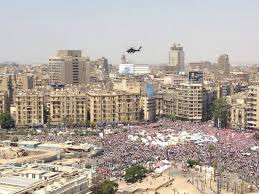
People were also really happy about the military flying helicopters above Tahrir. These were the same folks who were so pissed we sold them to Egypt. You're effin' welcome, Egypt (sarcasm).

Military helicopters above Tahrir.

Sometimes--okay, often--people ask me why I moved to Egypt. During bad days I cannot remember, especially after I've been assaulted or groped or dragged from a moving car or called a "dirty woman" by some a-hole on the street. Especially when I compare it to the United States, where I can run around DC in soffee shorts and a tank top and feel completely comfortable, where electricity almost never cuts, and where there are only "first world" problems. But then I spend the day with my coworkers and I love Egypt again. Or Mahmoud at the gym who thinks I kick ass and doesn't hit on me at all. Or my guy friends on whose shoulders I've literally cried when I feel like I can't take it anymore. Or when all of Egypt comes together, sheds the usually rigid social barriers and demands their rights and an improved future.

Tahrir filled to the brim last night.
That was the blog post I was going to write this morning, full stop. Then the opposition announced Morsi had until Tuesday at 5pm to step down or else. Then the military announced on Twitter they would make an announcement. On the bright side, the military announced an announcement on Twitter. That's kind of cool.

The contents of the announcement were less so. The Supreme Council of the Armed Forces, or SCAF, led Egypt after Mubarak's fall. They were also the ones who massacred Christians protesting at Maspero. They are also seen as the one institution that is on the side of the people--a common chant is "The military and the people, one hand." Many Egyptians are nostalgic for their rule--and that of Mubarak--remembering the past as a time with stability, economic growth, security, etc.

This afternoon the military, which said it did not want a role in politics, would nevertheless intervene in 48 hours with a "road map" should the political elite fail to heed the "will of the people." It praised the Egyptian people for astounding the world and emphasized it's "responsibility" to maintain the safety and security of the nation. In a collective act of amnesia, people are cheering this on.

So, folks, in 48 hours we will probably have a military coup. It won't be obvious--it'll be a sneaky coup. But that's what it is.

My physical safety is not at risk right now, for those at home. I live in the safest area in Cairo, surrounded by embassies--but far from that of the US.


Tuesday, June 25, 2013

Mafeesh benzine

There is no gasoline. There are huge lines at the petrol stations across the city. Egypt was scheduled to run out of strategic reserves by the month's end, but it seemed to happen overnight. We literally woke up two days ago to no petrol. Half the stations here are empty and dark, the other half have incredibly long queues that block traffic completely. There are rumors that the Ikwan did this to starve the people, but I do not think that is true. It would be like turning off the internet--it would only make people livid.

A petrol station in Cairo

Instead, I think the shortage has been made critical by the fact everyone here is panicking and running to fuel before this weekend's protests.  People see the long lines, freak out more, and the problem gets worse. It's like a run on the bank (which people are expecting here as well. Huge lines at the ATMs and no FDIC here, folks).

The shortage has coincided with an increase in tensions due to upcoming mass protests led by the Tamarod, or "rebellion," opposition movement.

Today my friend was late because he had to go pick up his boss, whose car ran out of gas. Midan Galaa, which I cross every day en route to the gym, is now permanently blocked with the cars waiting to be fueled. People are paying their bowabs and drivers extra to sit out for hours waiting for gas. Last night my friend was waiting in line for over three hours. Friends on Facebook are crowdsourcing petrol questions--where can I find gas? Where are the lines? WTF is going on? Are the Ikhwan cutting off supplies to stop people from going to protest?

A few days ago my friend works about 45 minutes outside Cairo. He got off work at 4:00 and called me at 7:30 furious--the road was so jammed he was not even able to leave the parking lot. Two hours after that he went to another friend's house to hang out closer to his work. It is now taking people four hours to get to places where it would usually take two.

Egypt's Ministry of Petroleum denies there is a fuel shortage. They live on Mars, apparently. Morsi spoke last night. For two and a half hours. He basically said rubbish, saying foreign fingers were influencing things, saying the Ministry of Interior would form a unit to combat "thuggery" and terrorism, including blocking of the streets. While admitting some mistakes, he blamed the media for bringing a negative light to the office of the presidency. Blah blah blah.

Monday, June 24, 2013

Mass panic

On Sunday, Egypt's opposition movements are planning on holding major demonstrations against the Muslim Brotherhood-led government. An activist movement, Tamarod, Arabic for "rebellion," claims to have collected 15 million signatures demanding Morsi step down. The expected major demonstrations have been prefaced by a sort of mass panic. People here see 30 June, the date of the demonstrations and the year anniversary of Morsi's ascendance to power, as the last hope to save Egypt. The ruling party and its allies have done little to quell fears of violence, saying in one breath it would be open to negotiations and in another calling the opposition "kufirs," or "disbelievers," and vowing to meet violence with violence.

Perhaps more worrying, the opposition itself seems to be bent on violence. Without massive violence, they rightly surmise, there will be no political change. Only with massive violence will the army be forced to step in and take out the Morsi government--this, to many, is the optimal result.

I had a conversation today where I was asked if I was optimistic about 30 June. What does it mean to be optimistic, I asked. Would I be optimistic to hope for little violence--which would mean Egypt's politics stay the same--or optimistic to hope for violence and an overthrow of the government.

I, for the most part, expect a repeat of the clashes in December after Morsi's power-grabbing presidential decree. I honestly cannot picture Egypt descending into chaos--I use this as a relative term, of course. Many think it's already chaotic, although I think it's at an uneasy balanced point. Everything is constantly in flux, and yet nothing ever changes. It'll be ungodly hot, the opposition is divided, and thus far the Muslim Brotherhood says it will not go down on 30 June. They have so far allowed these protests to go on and let them die out--perhaps the smartest course of action in terms of international attention. The Muslim Brotherhood can point to the demonstrations and say there is increased freedoms, and the demonstrations eventual peter out.

Whatever happens, there is only a week for the change as Ramadan soon starts. No one will go down when they're hungry, tired, and hot (which I, selfishly, am thankful for, as my mom is scheduled to be in town).

But there are many expecting mass violence, blood in the streets. It's an existential crisis on both sides. The opposition sees the Morsi government and the Muslim Brotherhood in general as just as bad, probably worse, than Mubarak. They are utilizing religion to steal power, and the opposition wants nothing less than to overthrow the government.

The Muslim Brotherhood, however, is unlikely to give up power, as they too rightly surmise that negotiating, that stepping down would mean prison in the best case, death in the worst. Last month, a senior Muslim Brotherhood member's son was beaten to death in a small town in the Sharquia governate. The murder was in retribution for the son's alleged shooting of an opposition activist over a Facebook post critical about his father. Opposition also openly call for the assassination of the president and killing of his supporters, neither of which are conducive to negotiations.

All anyone here can talk about is what they think will happen. Most people expect massive violence. Our office is closed on 30 June and people are being told to stock up on food, water, and money with the expectation of empty ATMs. There are huge queues at the petrol station, caused partly by a disel and gas shortage, partly because people are panicking and trying to get as much gas as they can. My boss, worried about a crazy young female foreigner, is trying to get me to leave town.

Anger is boiling at the United States, which is perceived to have stood behind the Morsi government. On the one hand people say the United States has not come out forcefully enough for its values and against the government, and on the other hand say the United States has been too supportive of the Muslim Brotherhood and unwilling to stand up for its values and beliefs. In other words, the United States is at once perceived as doing too little and too much meddling. I am up to my eyeballs in anti-US sentiment, although I am yet to give up on trying to explain the United States' complicated stance.

People have said this all before, however, and nothing has come of the demonstrations. People have gone down, said their spiel, and gone home. Demonstrations were followed by isolated clashes at night, but life went on semi-normally. 

Wednesday, May 22, 2013

"My Barbie came to life!"

When Shruti first suggested going to Goa, I was hesitant. When I thought of Goa I thought of debauchery and Russians.  If I wanted to go to a dirty, shitty beach I would just go to Hurghada or Sharm. 

Despite my initial misgivings, I went along with the Goa idea and am glad I did. Yes, it's a beach paradise. But there's a lot of history, a lot of local culture. I would never have seen this part of India otherwise. 

Goa is incredibly lush and green. Also humid- I stepped off the plane and my glasses fogged up. The population here is heavily Christian, leftover from the years as a Portuguese colony.  In fact, the Portuguese were kicked out at least ten years after partition by the Indian army.  Left behind is the religion, the food, the architecture, and the port wine.  

We stayed at a bit of a nicer resort for the wedding, which I'm happy about after spending a few hours in Baga Beach, an area of Goa that lives up to the Russian stereotypes.  Also whenever we left I got hollered at. Again, it's what I'm used to from Cairo. Although unfortunately Cairo conditioned me to tense up in expectation of physical harm to come. 

Shruti was surprised about the attention we/I got. We were walking around a fort and these guys kept on following us and talking. She said she never understood harassment until she walked around with me. You're welcome, I guess.  I told her its okay, that I'm pretty used to such attention and treatment because of Egypt. Except in Egypt the boys would have pushed us down the stairs or thrown garbage at us. At least Indian guys-knock on wood- haven't caused me physical harm. Yet. 

She also said she didn't realize she lived in a country full of creepers until she traveled with me. There were stares--I was really one of the only white people I saw in Goa. It was offseason so those visiting were all Indian. There were a few families who asked to take a photo with me. Again, I don't really care. There were some people who ran up to me a took a photo and ran away.  Perhaps a bit strange.

This morning a little girl walked up to our table at breakfast. We turned to her and tried talking to her, asking her name and everything. She just sat there, speechless, looking like she was about to say something but not quite able to spit it out. Her dad eventually came by and pulled her away.

"She was like, 'Ohmigod!'," said Shruti. "' My Barbie doll came to life!'"

Saturday, May 18, 2013

"They don't exist"

When I told people I was going on holiday to India, many asked me why? Why would I holiday from a country with horrendous traffic, pollution, and sexual harassment to another country with horrendous traffic, pollution, and sexual harassment? Why not something fun and easy, like Spain or Greece?

I love India. It's my home away from home away from home (the other two being the US and Egypt). I love the craziness, the colors, the sounds, and yes, even the smells (maybe not so much the BO but more the spices, the incense, the flowers).

So here I am, in India. I'm visiting a friend in Bangalore and we will go tomorrow to Goa and later to and around Mysore. We are spending a lot of time with her mother, who I love. She is one of the nicest, kindest people I know.

Earlier this afternoon we started talking about the men on the street. I told her how Cairo has obviously scarred me. I see groups of young men and I instinctively tense up. It's a bit difficult to breathe and I brace myself for some kind of altercation. This is not normal, but after being groped and dragged from a moving car in Cairo (why? I'm assuming because I had the audacity to walk on the street) one does tend to make these assumptions.

Both countries' media portray sexual harassment and assault in a light way. I've seen numerous Egyptian movies where a guy will be slapping, hitting, punching, shoving a woman and the scene is obviously meant to be humorous. Despite all of our flaws, I can hardly imagine sexual assault being portrayed in such a way in the States. Our movie stars may be hoochie mamas, but our sexual assaulters are always the bad guys. According to my friend's mom, many Bollywood movies are the same too.

Like Egypt, the society here is quickly becoming increasingly conservative. Where five years ago women could wear basically whatever they want, now many choose to dress more conservatively so as to not attract attention or be harassed on the street. This is most definitely the case in Egypt. During my parents' and grandparents' time, apparently women walked around Cairo in short skirts and tank tops. Now I change out of my work clothes--which by definition are not sexy and cover the mandatory knees and shoulders--to walk home many times. Instead of wearing pants, I'll wear a long skirt, for example.

My friend's mom said her maid likes it when her husband beats her--it means he cares. This is apparently a not uncommon belief among sectors of the lower class here. Men too believe women like being beaten. I have not hear this belief exactly in Egypt, but I would not be surprised were it common.

Like Egypt, there are plenty of motor scooters (although unlike Egypt, women ride on them and even drive the vehicles themselves). I noticed when a man and a woman would be on the scooter the man would always have a helmet and the woman would have no protection. I commented on this, saying I was surprised and would have thought the men would give up his helmet for the lady on the back, most  likely his sister, friend, or wife--someone dear.

"They don't exist," answered my friend Shruti, referring to the women.

On a lighter note, as I was writing this the power cut--just like in Egypt. Ahh. It's like I'm home.